
Blog Entry
Over the weekend Crucial Web Hosting released a new module, KeyAds, that lets you better target content (or ads) to visitors.
KeyAds is a module for ExpressionEngine that allows you to display content to your visitors—like an ad or block of HTML code—based on keywords they enter in a search engine, or based on the referring domain.
This is a fairly common tool, so it’s nice to see this come to ExpressionEngine. The module seems easy to use and you could even combine it with an ad server like OpenX to display certain ad zones depending on keyword or referrer.
The module is currently only available for 1.6.8 but I’m hopeful a 2.0 version will be just around the corner.
Learn more: KeyAds Module by Crucial Web Hosting
Blog Entry
Viget author Doug Avery has written a great article on Structure and the perfect setup.
Even with the EE 2.0 release in December, I think the best ExpressionEngine event in 2009 was the rise of Travis Schmeisser’s Structure. While 2.0 lays the groundwork for a bright future, in the short run it’s more of a step backwards because so few of EE’s amazing community-built addons have been ported so far - even with new functionality, a 2.0 upgrade takes away far more than it gives at the moment.
Be sure to check out the rest of the article for a well-written and reasoned article on doing cool stuff with Structure.
Blog Entry
There are two ExpressionEngine tag modules being released today. The first one Tagger Lite is being released by Parscale Media. What does it do?
Tagger Lite allows you to tag all your Expression Engine entries. This powerful module allows you to add “Keywords” to your entries in a new simple integrated solution right within your entry tabs. This allows you to showcase content by tag and create tag clouds within your Expression Engine templates.
In the other corner we have the beta of Taggable a new module by CodeIgniter Chieftain Jamie Rumbelow. What it does may shock you!
Taggable is an easy-to use, powerful folksonomy engine designed exclusively for ExpressionEngine 2.0. It works with any channel entry, so you can add tags to your blog, news archive, pages, photo gallery - anything that’s powered by a channel! It features a rich set of template tags that let you list, filter, and display tags and their entries with no code necessary.
Indeed, it is a glorious day to be a tag.
Blog Entry

We’re back! Dan and I have finally synced up our schedules again to bring you another episode of the EE Podcast.
Here’s a summary of the episode:
In this episode, Dan and Ryan talk about Playgrounder.com, a site Dan built, covering all of the latest and greatest toys and gear for kids. We cover the add-ons he used and a couple of tricks to make the site work without heavy customization.
Subscribe, listen or download: EE Podcast 10
Blog Entry
Infamous ExpressionEngine add-on developer, Brandon Kelly, has written an article on paid upgrades.
The new fad in ExpressionEngine Land appears to be paid upgrades. EllisLab is charging $50 to upgrade EE1 to EE2, and what’s more, they plan to charge for some 2.x upgrades as well. Following EllisLab’s lead, Solspace has announced that they will start charging for major upgrades as well. They’ll begin with User 3, which will cost $9.95 to upgrade from User 2.
SPOILER ALERT: Brandon Kelly is not charging for upgrades.
Blog Entry
Continuing their ongoing series, Devot:ee has spotlighted developer Anna Brown. The article goes into, as previous articles, what tools Anna uses to get the job done and what she has built. Who is Anna?
Anna Brown is a wildly successful web developer and the owner of MediaGirl, Inc. Among many other projects, she developed Zocalo, a Spanish language daily newspaper that is the fourth largest ExpressionEngine site on the internet according to Hop Studios’ yearly round-up. Her sites push the boundaries of ExpressionEngine in scale and capability, and she shows the rest of us what’s possible with ability, hard work, and over 1 million unique visitors a month.
It’s an excellent read for any developer.
Blog Entry
 EECI 2010 speaker and prominent early member of the EE community, Mark Huot, was one of the first real extension contributors to the EE community. With the release of ExpressionEngine 2, we’ve invited Mark to answer some questions about the earlier days and what he’s looking forward to most.
1. How long ago did you start developing add-ons and what prompted you to? What drew you to ExpressionEngine vs. another option?
I started developing add-ons in 2006 out of necessity. We were facing a particularly aggressive timeline and our original CMS vendor pulled out part way through the definition. By this point our requirements were pretty much set (and signed for) so we needed a system that would be flexible enough to bend to our needs (custom fields were pretty much the primary selling point). We were fortunate enough to talk to Leslie on the phone and bounce some ideas off him before diving in. He put us in touch with Mitchell (of Solspace) and through that partnership I built my first extension (the Multi-select Drop-down) under Mitchell’s care.
2. What challenges, when you initially approached development were slowly erased over time? Are any of those re-created with the new beta?
I’m a “code” learner, not a “documentation” learner, so the biggest challenge for me was getting accustomed to the EE coding style and architecture. It’s not particularly complicated or unique, but it still took some time. Luckily with EE2 built on CodeIgniter, I can leverage (yea, I said leverage) my existing background with the framework to dive right in.
Beyond that, and contrary to my learning style, I’ve always wished for some better documentation around the “public” functions. EL has done some of them (here’s one), but never got to the Localization class.
3. How do you approach building an add-on? What are you first-steps? How do you plan the development cycle?
My first step is diving right in. I’ll write out as much of the code as I can without ever testing or loading it in a browser. I get a basic abstract class definition created, some sample methods and even some theoretical XHTML down in code. Then I go back and just make it work. It’s sloppy and bug ridden, but in a few minutes I can see, at face value, whether the idea has legs. If it does, I start over. I take what I like and drop what I don’t. This is when I get anal over line lengths, code wrapping and whitespace. But the key is that I’m not exploring any more. I have the idea down, I know the approach to take, all I’m doing is performance tuning and finessing.
4. What aspiration do you have for EE2? What does CodeIgniter as a base do for you as a developer or aid you?
Phew, a lot. When I was first getting started with EE I fell in love with the drop dead simple templating language. It was easy to learn and even easier to implement. Now, though, as my coding skills improve, and more importantly, my database skills, I find myself wishing I had more control over the templating language. So as a developer, I’m excited, and hopeful, to see CI views on the front-end (not just in the control panel).
[far too technical moment: I’m also hoping that EE2 optimizes some of it’s template meta work to the filesystem and out of the DB as it has been in the past]
5. What is the biggest piece added to EE2 that helps you? What is the biggest piece missing from 2.0?
The biggest addition I’m looking forward to is the structured development platform. Separating Modules out into models, views and controllers will streamline my development process and allow me to reuse a lot more of my code than I have in the past. I see a library of views cropping up that can be re-used as needed. For example a “list” view, an “options” view, a “summary” view, etc… Oh, that and a reusable “exp_weblog_titles” model  .
.
The biggest piece missing may have been alluded to in my last answer, but from my very early peaks I haven’t seen font-end views implemented as I would have hoped. It seems that views are kept in the CP so it may take a little bit of work to get them truly working on the front-end as first class citizens.
6. Do you have any intention to use accessories with your add-on? If so, what for?
I do, and I hope others do as well. Accessories are great ways to provide your users with an omni present UI. Say you were building a file manager. Integrate an accessory with your file manager and suddenly your users can browse their files from anywhere. Give Accessories some time to mature and I think we’ll start to see all sorts of cross-talking accessories accessible from anywhere in the CP.
7. Overall, as an EE user what has pleased you and disappointed you most with the ExpressionEngine 2 beta?
Personally, I was very pleased with the beta. The support staff was reachable throughout and as far as I could tell, quite attentive to any testers needs.
8. Do you have any plans to build extensions now? A lot of your extensions are getting on the old side, and were developed for client work?
I do have plans to get back into add-on development. Probably slower than I did originally, since the support quickly outweighed the development though. I’ve got some interesting clients on the horizon with some interesting problems to solve. As you can see from my previous answers, I’m really looking forward to diving into EE2’s `views` and see what sort of awesomeness lurks in the dark corners.
Our thanks to Mark Huot for his interview. You can find his EE client work at his company’s site Happy Cog and his EE extension work at docs.markhuot.com.
Blog Entry
Coda is a popular Mac editor for ExpressionEngine. With the new version of EE comes, of course, a change to some of the template tags. Jason Hudnutt of Invoked Projects has your solution.
If you are unfamiliar with clips they are an extremely useful feature that Panic has provided inside of Coda. Clips are essentially “snippets” of code that you can reuse to speed up your time for habitual coding tasks.
The forum post, which is dated September 2008, is actually up to date with the current links. Thanks to Jason for putting this together.
Blog Entry
This one came up a couple of weeks back in the EE Help Chat. Someone asked if there was a way to do recurring payments with Simple Commerce Module and EE. The answer is yes and no.
In the 1.6.x version of the Simple Commerce Module (included with all paid licenses of EE1 .6.x) you could not do recurring Paypal payments. But now 2.0 supports recurring payments in the new version of the Simple Commerce Module.
Read the full Simple Commerce Module documentation to get all of the details.
Blog Entry
Over in the forum, imagehat studio announced the availability of a new wiki theme called EEDoc. The theme takes the EE wiki module and makes it look more like the official EE documentation.
The theme is a free download and even comes in versions for both EE 1.6.8 and EE 2.0. Nicely done!
Read the forum thread announcing EEDoc.
Blog Entry

Time for everyone’s favorite feature, your weekly Devot:ee.
Blog Entry
Champagne has been released, and it integrates heavily with Campaign Monitor for $35. According to its web site, Champagne has the following features:
- Publish email campaigns in EE and use EE templates to render HTML & text versions of campaign
- Reuse existing EE content and/or add content specifically for email subscribers when creating campaigns.
- Content authors can use a single interface to publish web content & email campaigns.
- Use EE tags to create a Campaign Monitor subscriber form. Custom CM fields are supported.
- View summary email campaign statistics after delivery.
- Customize the tab that is added to the EE Publish Form to match your CM branded product.
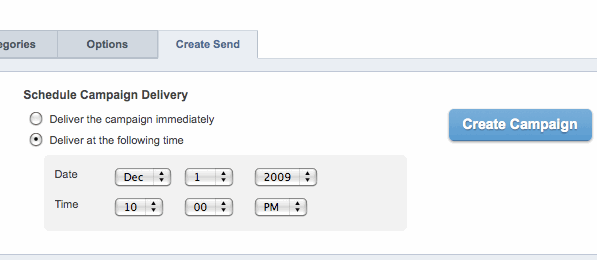
Sending a Campaign with Champagne
We can’t recommend it quite yet, because we haven’t played with it, but its feature set looks great. Let us know in the comments how it is!
Blog Entry
We missed this last week, but Devot:ee has a great article on updating plugins from 1.6.8 to 2.0. The article covers plug-ins as well as some entry level development instruction.
The biggest functional difference between 1.6.8 and 2.0 as far as plugins are concerned is the switch from global variables and methods to the super object. Most of your calls will still work the same, but they’ll be formatted differently and interact with ExpressionEngine in a new way. These changes first show up in the plugin constructor function, which is the first function in the plugin class.
The post is lengthy, well-written and full of great beginner information.
Blog Entry
Mitchell Kimbrough, better known by his company’s name Solspace, was one of the first EE developers on the scene. We asked him questions regarding his current add-ons and the release of ExpressionEngine 2.0 to determine what has come before, and what we can expect in the future.
1. How long ago did you start developing add-ons and what prompted you to? What drew you to ExpressionEngine vs. another option? If you could, recap Solspace’s release history, with some highlights of challenges with the EE builds at that time?
I began writing add-ons for EE back in early 2004, but I can’t prove it. The earliest evidence of an EE add-on is from the Rating module from early 2005. I remember that a client wanted rating capability on his website. It occurred to me that I could take the Comment module and use it as a base for a rating module.
I was drawn to EE because I was already committed to its predecessor pMachine Pro. I had used pMachine Pro as a CMS successfully on a few sites. I initially chose it because the code looked clean and crafted, though I didn’t know a thing about PHP or MySQL at the time. Choosing pM Pro and later EE was the critical business move I made that got word of mouth to spread. Few people in my area of the country were using a blogging tool as a CMS yet. I resisted EE initially because of how it used templates, but I quickly changed my mind when I saw how it could allow me to accept incoming clients with ever expanding needs.
The history of the early Solspace is really all about responding to client need. I saw a market for add-on software for EE every time a client asked if EE could do a certain thing that it could not in fact do. I just started saying yes to everything and figuring out how to build it later. Those were painful years; many floggings from Paul.
The most notable EE challenge in the early days in my view was the fact that you could not initially publish to a blog from a front-end page. That’s why I wrote Freeform. I needed to accept user submissions to a contact form. I wanted to have them submit to a blog, but there was no capability for that. So I saw the need and opportunity for a flexible form submission tool. I was sure that Freeform would be obsolete once the SAEF came about. I was so wrong. That’s one of my favorite lessons. I employ it to this day. I call it, “I don’t know!” I don’t really know what the market wants. Only the market knows. So I have to find a way to write software, release it and see if it floats. I’m almost always surprised by the market.
2. What challenges, when you initially approached development were slowly erased over time? Are any of those re-created with the new beta?
Legitimacy was one of the big challenges that was slowly erased over time in EE. When I first started I was one of a handful of developers using the tool seriously. It had to be a unique client who had the stomach to risk their project on a really cheap, practically free, CMS tool. EE was not legitimate in the old days; mainly because it was not reassuringly expensive.
As more people came online to use the tool, there at the same time seemed to be more clients coming online who were comfortable taking more of an open source type approach to web development. I don’t think EE really did anything in particular to remedy the legitimacy problem. We developers did. EE definitely supported us and improved its stability and security over time. Rick, Paul and Les were stable influences who created bedrock that a community could build and reach stability upon.
3. How do you approach building an add-on? What are you first-steps? How do you plan the development cycle?
When I build an add-on I first ask if I can get it out the door and into people’s hands on a timeline or for a price that is manageable. I try and follow the maxim that, “I don’t know.” I don’t know what’s going to get traction in the market. I try to choose projects that can get their wheels on the ground quickly in order to get market feedback.
My development cycle is almost wholly dependent on a representative of the market, usually a client, telling me what they need from a given add-on. The Friends module was developed in this way. A client needed to create a local version of Facebook on their site. Facebook Connect hadn’t been released yet, but they wanted that functionality; friends, groups, messaging, etc. I coded the module for them and pushed it to meet their needs.
When I was done with the first version of Friends I looked at all of the work and I looked at the end result and I was disappointed. It took so much time to get the thing running on a site I thought that people would eventually reject it. There was sufficient demand for it from the market that Kelsey and I decided to power through and finish it. We solved the problem of installation complexity by developing Code Packs. Code Packs are like a just-add-water starter kit for an add-on or mash-up of add-ons. You click a button and immediately have a fully functioning Friends site up and running.
We’ve all heard that necessity is the mother of invention. Well problems are opportunities in my view. The Friends / Code Packs combo is an example of that. It’s a good example of our development process. Find yourself faced with a challenge in EE. Turn that into an opportunity through some clever software solution. Develop it in a way that you can share it / sell it to others.
4. What aspiration do you have for EE2? What does CodeIgniter as a base do for you as a developer or aid you?
My aspiration for EE2 is that it be recognized as a development platform for web applications. For years Solspace has used EE less as a CMS and more as a web development platform. We can use it to create almost anything for a client. In my view, EE2 is a response to and validation of that fact. When I look at EE2 being built on CI, I think that EllisLab has acknowledged that its future is not in blogging, not in CMS’ing, but in serving as a platform for collaborative web developers. I embrace this and think it wise and prudent.
5. What is the biggest piece added to EE2 that helps you? What is the biggest piece missing from 2.0?
At this very moment I am not thinking a lot about what pieces have been added to EE2 versus what’s missing. If I was running EL I would have done exactly what they did. Once the decision was made to run EE on top of CI, I would have set the first goal as to simply port all of EE 1.x to EE 2.x. Get that new rascal stable and secure. THEN and only THEN, go full blast on building out the possibilities of the new platform.
6. Do you have any intention to use accessories with your add-on? If so, what for?
I will definitely make accessories available in Solspace add-ons. I think people will turn a lot of them off, but they should be made available. They’re easy to write and they are nice at-a-glance tools. I like that feature of EE2.
7. Any new things to look forward to in 2010? Can we expect more entries in the performance series?
We are almost done with the performance suite, which includes Template Morsels, Static Page Caching, Super Search and Preparse. It’s funny, the performance suite is essential to us and our clients, but when I see feedback on the add-ons that make it up, people are always asking for cool new features rather than faster performance. We’re either ahead of the curve with the performance issue or EE performs perfectly well for most people out there.
The performance suite makes the case for where I want Solspace to go. I want Solspace to be one of the pillars of the EE community. I want our products to be essential equipment for serious EE developers. If we can quietly become an essential part of your toolkit, if we can serve you as you serve your clients, I will be very pleased.
As for 2010 releases, we have some killer gear coming out. But to be frank, most of our time in the first part of the year will be spent converting our library to support EE2. We will continue to support EE1 for years to come by the way. We think it still has a nice long life left in it.
8. Overall, as an EE user what has pleased you and disappointed you most with the ExpressionEngine 2 beta?
The EE2 beta disappointed me with the lack of extension hooks. But I will be honest and blunt. It’s a relief. We were very busy. If the beta had come out and been completely ready to support all of our add-ons, we would have been hard pressed to convert quickly. There really is a lot of work to do. And by the way, I would have done what EL did with its beta release. I would have kept it as simple as possible and gradually built into releasing the full monty.
9. We are now looking at the EE2 public beta, what challenges are you facing in EE2’s current iteration with your released Solspace add-ons?
As above, some add-ons can’t even be touched yet. The necessary extension hooks do not exist in EE2. I think there are some architecture ideas still floating around EE2 that are being resolved and finalized. As you code and develop you encounter opportunities along the way. Sometimes a block of code, written differently, explodes the opportunities exponentially. I think that some of that is happening with EE2. We’re patient and have plenty to occupy us in the mean time.
Blog Entry
We know many of you use Panic’s Coda as your primary developer tool and for good reason. In the ExpressionEngine forums, there was a question about getting the Coda Live Preview functionality working. PeeTer asks the following:
Hi, I’m using EE 2.0 and since I upgraded the “live preview” trick mentioned in this blog post has stopped working. Has anyone figured out how to make live preview work again with Coda using EE 2.0?
http://www.expressionengine.com/blog/entry/live_preview_with_coda_and_other_ides/
To find the answer (from Dr. Jones no less), read on.
Blog Entry
Taking a page from ExpressionEngine.com’s Showcase Feature, Devot:ee is now Spotlighting Developer Chad Crowell.
Who is “The Knife”?
Chad Crowell is a web developer who runs web marketing agency Encaffeinated by day and develops ExpressionEngine add-ons by night. His add-on credits include Direct to Structure and Friendlee Date, both popular and useful add-ons. He’s also so edgy that we had to blur sections of his spotlight images and it’s rumored that he stunt doubles for Kiefer Sutherland.
You can read the great spotlight interview here.
Blog Entry
One of the best EE add-ons for anyone with a blog, Low NoSpam is now compatible with EE2.
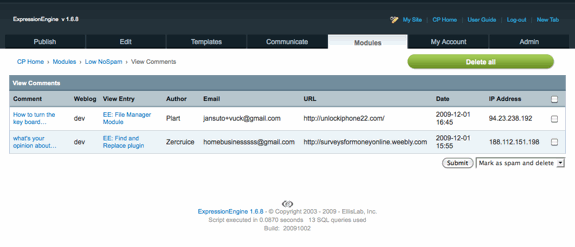
Low NoSpam Interface
We here at the Insider can not say thanks to Low enough for this excellent add-on, as it keeps our comments lean and mean while spam-free. This add-on is highly recommended.
Blog Entry
I love cheat sheets. They provide great quick-references when you just can’t remember a little piece of code. I especially love well layed-out cheat sheets. I really, especially love well laid-out cheat sheets about ExpressionEngine development.
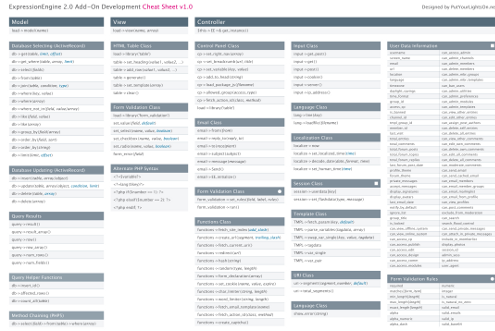
The EE 2.0 Developer Cheat Sheet
Fortunately, PutYourLightsOn created one, and it’s great.
 Add Your Comment
 Share on Twitter